
Join us on a journey through history, where the air thins and the earth’s colors sharpen into shades you never knew existed. Here you’ll discover Ausangate.
This is no ordinary mountain. It’s a mountain so majestic, the locals say it’s alive.
To Andean communities, Ausangate isn’t just rock and ice. Not at all. It’s an Apu. A sacred mountain spirit that watches over those around it. More specifically, Ausangate is the Apu of Abundance, particularly wealth, fertility, and prosperity.
So it’s no wonder such an important mountain holds stories within. Tales of legends and rituals, still told today by the Quechuan people in the region.
Are you ready, brave adventurer, to learn more? Here we go.
Table of Contents
A Mountain As Old As History Itself (Or Older)
In Incan times, Ausangate was worshipped as one of the most important sacred sites in the empire, but its significance goes even further back. Much further, in fact, to pre-Incan cultures like Wari and Pukara.
Archaeologists have found ceremonial offerings buried miles above where people should reasonably have been living, proving that Ausangate has been a holy place for over 4,000 years. Wow!
But back to Incan times where they had a network of sacred lines from Cusco called the ‘ceque system’. Ausangate sat on one of the most important lines, which meant it played a big role in ceremonies involving water, harvests, and even astrology. The mountain wasn’t just worshipped. It was consulted like an oracle.
How Ausangate Became An Apu
As with all cultures, the Andean people tell tales of how humans came to be and what the world was like back then. One story claims that when the first humans emerged from the sacred cave of Pacariqtambo, they were weak and cold. The world was still young and hostile.
After seeing their suffering, four mountain spirits descended from the heavens to protect them. Each chose a peak to inhabit. One chose Ausangate and it brought:
- warm winds to shield crops from frost.
- crystal water to fill rivers.
- minerals deep within the rock.
- llamas and alpacas, said to be gifts woven from the clouds.
As long as the locals respected the mountain, they would enjoy prosperity, thus beginning a pact that still stands strong today.
The Legend Of The Two Serpents
This old Quechua tale is about Ausangate and Salkantay (another sacred peak to the northwest). They are described as brothers and both were destined to become Apus, but while Salkantay chose strength and war, Ausangate chose abundance and peace.
One day, the gods asked them to prove themselves, so they each sent a spirit in serpent form.
Salkantay’s snake was enormous, black, and very fierce. Ausangate’s was bright and shimmering with colors.
The serpents came face to face in the valley, but instead of fighting, Ausangate’s serpent offered water, winding around springs and rivers to bring life to the land. When Salkantay saw its brother’s wisdom, it simply bowed, and the gods awarded Ausangate with the title of Apu of Abundance.
Nowadays, some say that the rivers that flow from Ausangate follow the path that the shining serpent once travelled.
The Golden Lake Of Ausangate
Another story tells the tale of the lake Qoyu Qocha that sits high up in the mountain. It means Golden Lake, and legend says that it was formed when Ausangate shed tears of light for humanity.
Want to know something extra special about this lake? Instead of reflecting your face, it reflects your future.
If you arrive with a pure heart, you’ll see visions of what lies ahead, whether it be blessings or warnings. If you arrive full of greed or deceit, you’ll only see swirling mist or NOTHING. It’s as if the mountain doesn’t want to acknowledge your existence.
You might hear tales of travellers who came back and their dreams came true, like marriage, birth, and even fortune. Then there are those who return in silence, shaken by their experience of what they saw. Or what they didn’t.
The Humble Shepherd
A popular story among Quechua families is about a young shepherd called Yanaqocha, who was known for singing to his alpacas.
One night, when he was out in the fields, there was a sudden storm and he lost four of his alpacas. But he didn’t run home to tell everyone what happened. He was too afraid of the village elders, so climbed the slopes of Ausangate to search for them.
He didn’t find his animals, but he did find a shining silver and gold man standing at the cliff edge. It was Ausangate in human form, and it offered the shepherd a choice – wisdom, wealth, or bravery. He chose the latter, believing it was the only one that could truly help him live a good life, and the Apu smiled, touched his forehead, and vanished.
The next morning, Yanaqocha woke to find not only his missing alpacas but dozens more. The herd could now grow so vast that it could support the whole village for generations.
The moral of the story? If you choose inner strength, abundance will soon follow on its own accord.
The Mantle Of Ausangate: Vinicunca
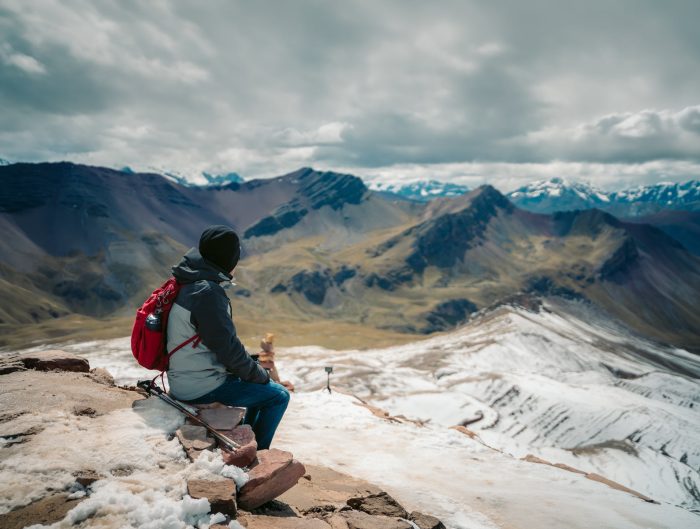
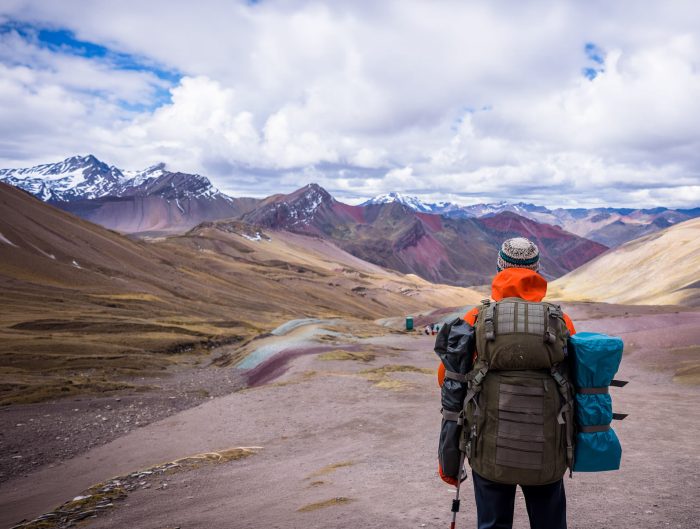
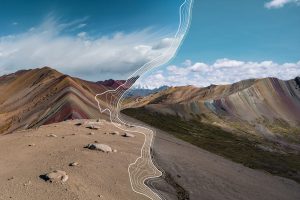
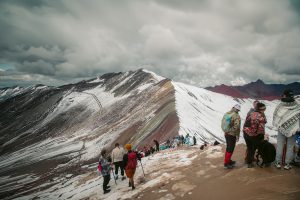
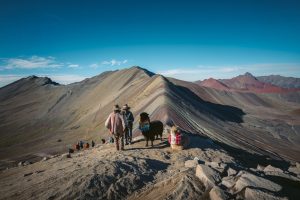
Ever heard of Rainbow Mountain? We thought so. That’s what Vinicunca is more famously known as. Well, this colorful mountain sits close to Ausangate, and locals say the colors are the mantle of Ausangate, laid over the earth below like a cloak.
Sure, geologists will tell you that the colors are made up of minerals beneath the surface, but many Quechua people believe they also signify certain spiritual elements.
- Red for blood and life
- Yellow for corn (the sacred crop)
- Green for the heart of Pachamama (Mother Earth)
- Blue for the sky
- Purple for the ancestors
- White for the glaciers (the breath of the mountain spirits)
Some local tour guides say that if you place your hand on the earth at dawn, you’ll feel a pulse, as if Apu Ausangate is stirring below.
Qoyllur Rit’i: Festival Of The Snow Star
For hundreds of years, people have flocked from Cusco and further afield to make the journey to Apu Ausangate to celebrate Qoyllur Rit’i, a.k.a. The Festival of the Snow Star. They still do it today.
The festival dates back to pre-Incan times and blends indigenous and colonial traditions, all the while keeping Ausangate at its heart.
Ukukus, the most devoted pilgrims, used to climb the giant glacier at night to cut huge blocks of sacred ice, which symbolized cleansing, rebirth, and the flow of abundance into their communities.
The glacier might be smaller nowadays and the practices have changed a little, but the spirit still persists.
If you’re ever lucky enough to visit Qoyllur Rit’i when in Peru, you’ll witness dancers, musicians, shamans, and entire families gathering in one of the most spectacular spiritual events on earth. It’s a living testament to the mountain’s power and the respect they hold for it.
Ausangate Today
So, your expedition of Andean mountain tales is coming to a close, but the Apus still stand strong.
In the modern world, it’s easy to feel rushed and disconnected, but Ausangate remains a place where the ancient pact between humans and the earth is still very much honored.
To the Andean people, abundance doesn’t just mean money or material goods. It’s their health, crops, livestock, and harmony with nature. Ausangate represents it all and is a great reminder that prosperity comes through respect and kindness.
Maybe that’s why travellers who stand beneath the towering mountain often describe the feeling of a presence. It’s as though the mountain knows they’re there.
In the Andes, mountains don’t keep secrets. They share them with those who listen.

You might also like
Leave A Reply